The Digital Humanities
The Introductory Session of the Digital Humanities Workshop Has Been Completed.
Selin Yavuz
3 min read
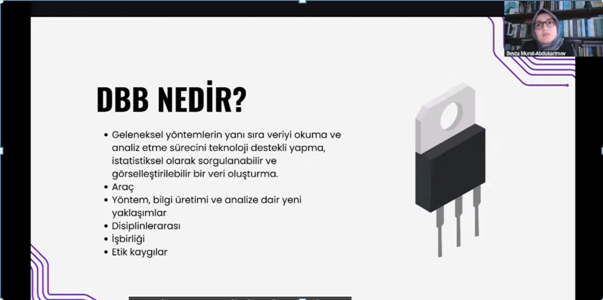
The introductory session of the Digital Humanities Workshop was delivered by Beyza Murat-Abdukarimov as an introductory lecture on Digital Humanities, offering participants a comprehensive overview of the field’s fundamental concepts, historical development, current areas of application, and the overall framework of the workshop. Rather than serving merely as an opening session focused on technical tools, the session offered an academic introduction that encouraged discussion on how digital methods can create new possibilities for research in the humanities. In the first part of the session, the general aims of the workshop and the activities planned for the coming weeks were presented. Participants were informed about the needs from which the Digital Humanities Workshop emerged, the research areas it aims to contribute to, and the methods that will be addressed in the following sessions. In this context, it was emphasised that the workshop seeks to familiarise humanities researchers with digital tools, enable them to adapt these tools to their own research topics, and help them develop an interdisciplinary perspective.
One of the key topics of the introductory session was the meaning of the concept of “Digital Humanities.” In this regard, it was explained that digital humanities is not limited to the digitisation of texts or the transfer of data into digital environments. Rather, it represents a broad approach that enables the formulation of new research questions in fields such as history, literature, linguistics, folklore, sociology, anthropology, and cultural studies. It was noted that digital methods allow researchers to work with large datasets, visualise relationships, analyse spatial distributions, and evaluate patterns across texts in a more systematic way.
The session also addressed the history of digital humanities. The development of the field worldwide was discussed within a broad framework, beginning with computer-assisted textual studies and extending to contemporary applications in data visualisation, network analysis, geographic information systems, and artificial intelligence-assisted research. This historical background was particularly important in demonstrating that digital humanities is a dynamic field that continuously evolves alongside technological developments. In addition, the development of digital humanities in Türkiye was discussed, with reference to academic studies, institutional initiatives, and individual formations in the field. Another important aspect of the session was the introduction of digital humanities centres in Türkiye and around the world. Participants were shown the websites of digital humanities centres operating in different countries, and examples were shared regarding their projects, databases, training programmes, and research opportunities. In this way, it was demonstrated concretely that digital humanities is not only a theoretical field, but also an applied area that develops through institutional structures, research networks, and project-based work.
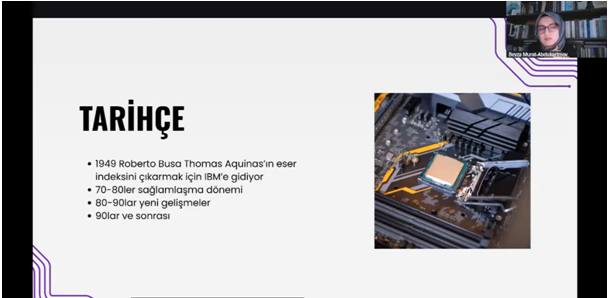
During the session, examples were also given from various articles and books published in the field. Through these sources, the theoretical framework, methodological possibilities, and applications of digital humanities across different disciplines were evaluated. Participants had the opportunity to see that the field is not merely a matter of technical skills, but a multidimensional area of research that must be considered together with questions of method, theory, data ethics, forms of representation, and processes of interpretation.
The introductory session also presented several subfields within digital humanities. Network analysis was discussed as an important method that enables researchers to make visible the relationships between people, texts, institutions, concepts, or places. Geographic Information Systems were introduced as powerful tools for examining the relationship between historical, literary, and cultural data and space. Automatic transcription applications were evaluated as a field that saves time and creates new analytical possibilities, especially for researchers working with manuscripts, printed materials, or audio archives. Text analysis was presented as one of the methods that enables systematic examination of word frequencies, thematic patterns, conceptual relationships, and discourse structures in large text collections. In addition, areas such as database creation, digital archiving, visualisation, mapping, and artificial intelligence-assisted research tools were also addressed.
In the final part of the session, information was provided about the team’s Digital Humanities Academic Network and the projects developed around this network. This section emphasised that digital humanities not only strengthens individual research practices, but also provides an important basis for collaboration among academics, the production of shared data, and the development of interdisciplinary projects. It was stated that the Academic Network aims to bring together researchers from different fields, increase knowledge exchange, and contribute to the institutionalisation of digital humanities in Türkiye.